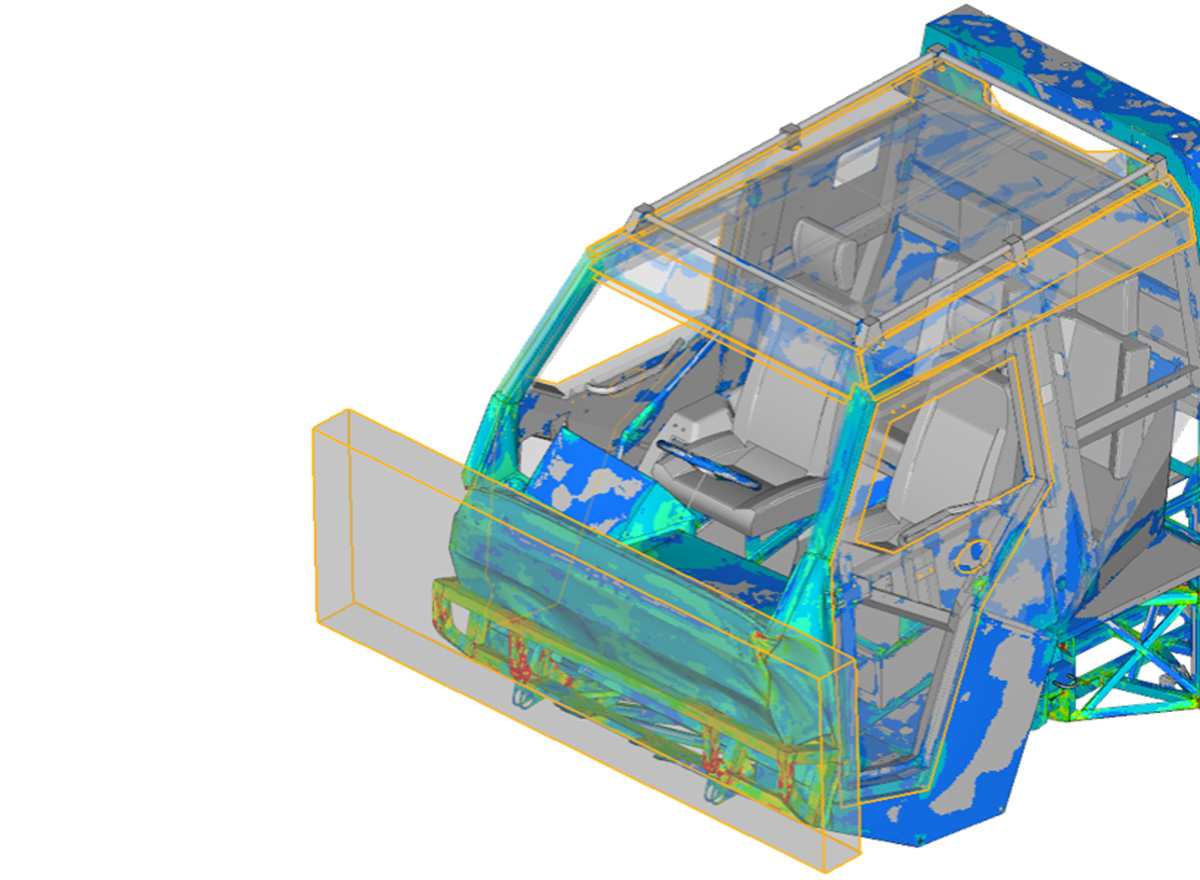
From regulatory load cases to unexpected impact events.
We use non-linear transient simulation to assess how structures behave during crash, impact, drop and rollover events. The objective is not simply to create a convincing animation, but to resolve the load paths, deformation, forces and failure mechanisms that determine performance.
Models can support concept development, design iteration, preparation for physical testing and evidence against defined acceptance criteria.
Crashworthiness
Structural response, intrusion, load transfer and energy absorption.
Impact & drop
Component and assembly response under short-duration loading.
Rollover & protection
Protective structures and whole-system dynamics through the event.
Regulatory assessment
Simulation of defined test conditions and structural acceptance criteria.
Assess the structure throughout the impact.
Regulatory impact models allow the development of deformation, local plasticity and load redistribution to be interrogated through time. Multiple views and section cuts can be used to understand what drives the response, not simply whether a final criterion is met.
The important details sit behind the animation.
Credible crash and impact assessment depends on representing both the event and the structure with the right level of fidelity.
Contacts & joints
Interfaces, fasteners, welds, joints and separations are represented according to the expected behaviour.
Material response
Modelling plasticity, strain-rate effects and material failure under representative loading conditions.
Loading & impactors
Mass, velocity, geometry, constraints and contact conditions reproduce the intended event or test.
Acceptance criteria
Forces, deformation, intrusion, energies and other measures are tied back to the engineering requirement.
Explore our wider simulation services.
Specialist support for demanding crash and impact programmes.
Our experienced engineers provide specialist simulation expertise, supporting both targeted analysis tasks and larger engineering development programmes.