Mine-Blast Fluid–Structure Interaction
Coupled modelling of pressure-wave propagation, material flow and structural response using Eulerian/ALE and Lagrangian methods.
Capturing the physics governing mine-blast loading.
Mine-blast loading is highly sensitive to soil density, saturation, compaction and composition, alongside charge configuration, burial depth and detonation location. These parameters influence pressure-wave propagation and the loading transmitted to the structure.
Represent the key material characteristics and interactions.
Coupled Euler-Lagrange modelling can represent the explosive threat, surrounding materials and structural response, including the pressure–volume behaviour associated with soil compaction. This enables the propagation of blast loading and transfer of energy into the structure to be assessed throughout the event.
Capture the interaction between structural deformation and blast loading.
Coupled FSI analysis accounts for the influence of structural deformation and confinement on material flow, pressure distribution and the imparted impulse.
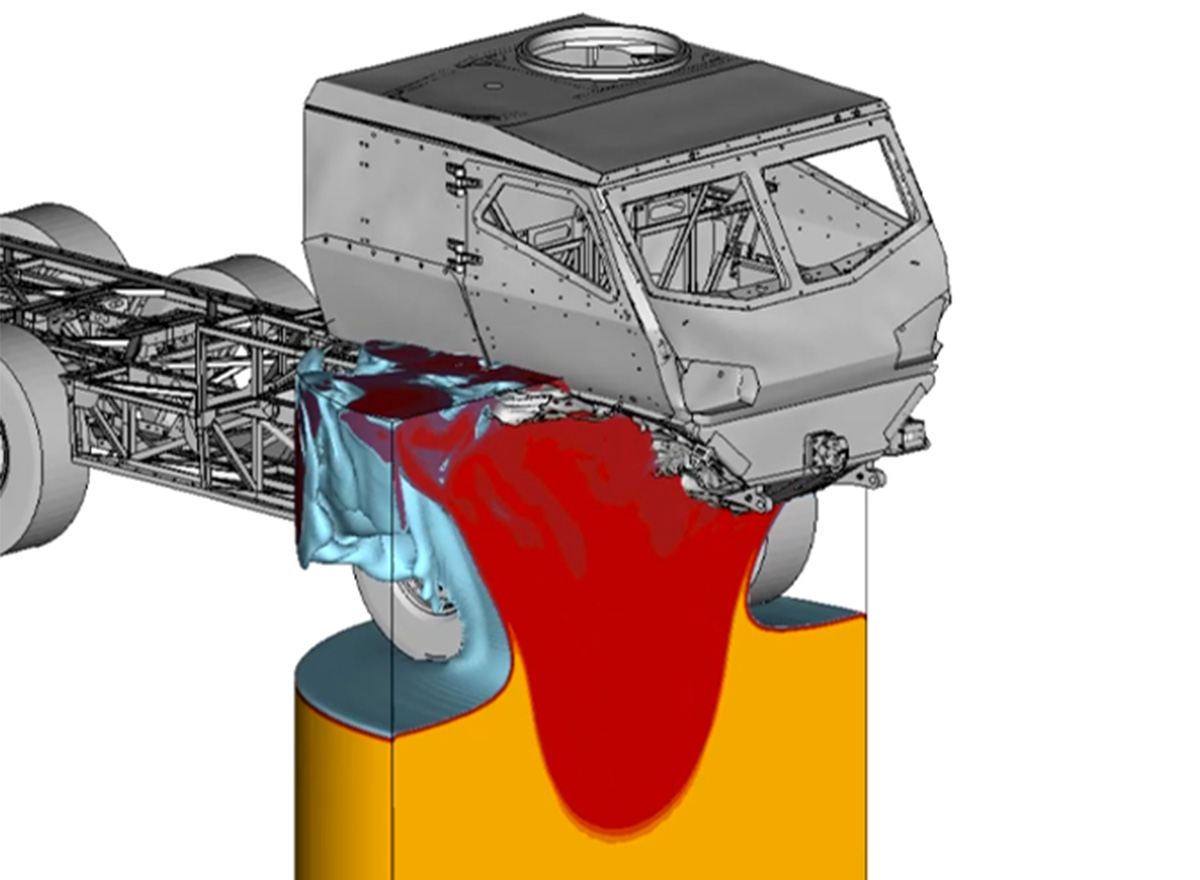
Visualising material flow beneath the vehicle.
The image illustrates material flow beneath a vehicle during a mine-blast event. Coupled FSI modelling represents the interaction between the expanding detonation products, surrounding soil and air, and the vehicle structure.
This provides insight into how structural geometry and deformation influence material flow, pressure distribution and the impulse imparted to the vehicle.
From pressure propagation to interface loading.
In a coupled assessment, complementary outputs allow the loading field and structural response to be examined through time.
Wave propagation
Pressure-wave evolution through the Eulerian/ALE domain.
Material flow
Motion of the represented materials, viewed separately from pressure contours.
Interface loading
Pressure histories, impulse and load transfer at the structural interface.
Structural response
Forces, deformation and energy transfer during the event.
Methods behind the case study.
Advanced coupled analysis, supported by in-house HPC.
Our specialist engineers and computational resources support demanding blast, shock and fluid–structure interaction assessments.