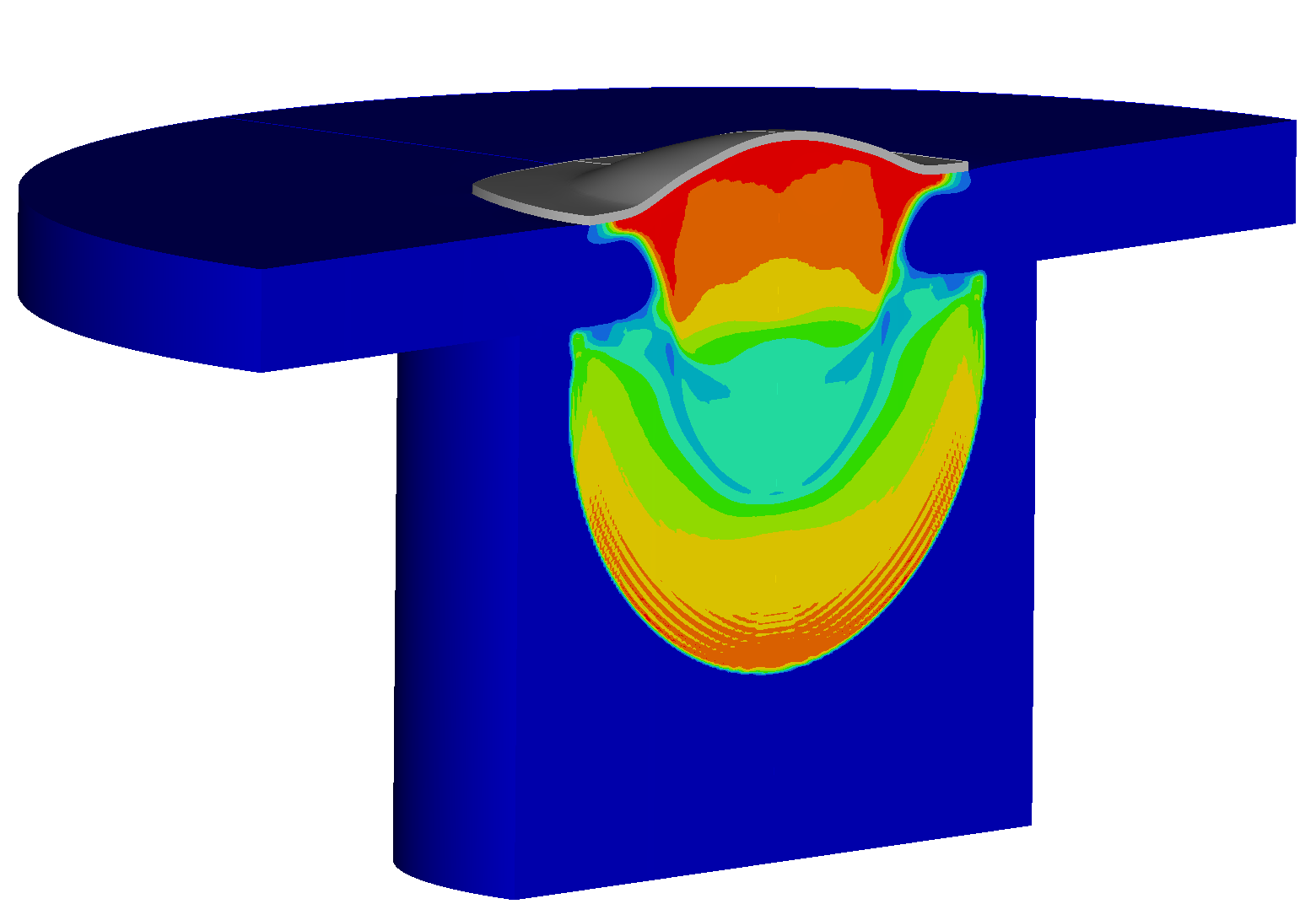
A structural load is sometimes the result of another simulation.
In a conventional structural model, the load is known and applied to the structure. In FSI, the loading field may evolve because of wave propagation, material motion and interaction with the deforming structure. That requires both domains to be represented and coupled appropriately.
We use Eulerian / ALE-style domains with Lagrangian structures where the problem demands this level of physical representation, particularly for highly transient events.
- Wave propagation influences the local structural load
- Material or fluid flow is part of the event
- Structural motion feeds back into the surrounding domain
- Applied pressure histories would omit important spatial or temporal behaviour
Visualising the evolution of a pressure wave through time.
The animation illustrates pressure-wave propagation through the computational domain. In coupled FSI analyses, we assess the resulting pressure histories, impulse and structural response, including forces, deformation and energy transfer.
Separate domains, one physical event.
Eulerian / ALE domain
Represents the propagating fluid or material field without requiring the mesh to follow the material deformation.
Lagrangian structure
Represents the structural components, contacts, materials, deformation and failure in the conventional structural frame.
Coupling interface
Transfers the interaction between domains so that loading and structural motion evolve consistently through time.
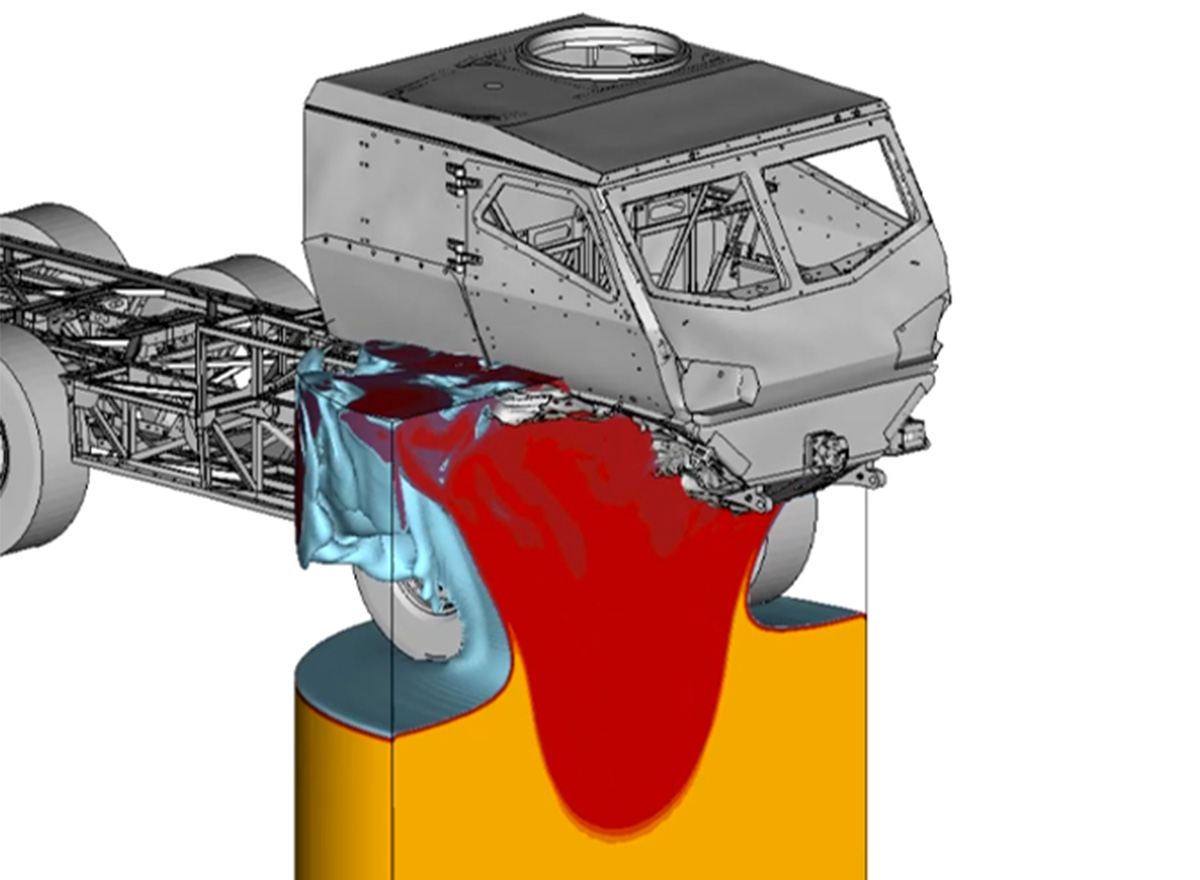
Coupled models add physics — and additional ways to be wrong.
FSI models are computationally demanding and sensitive to the representation of both domains. We therefore check domain resolution, interfaces, leakage/coupling behaviour, energy transfer, time histories and structural response together rather than relying on an animation alone.
See blast simulationFSI sits at the intersection of transient loading and structural response.
Does your loading environment need to be modelled, not assumed?
We can help assess whether coupled FSI is warranted and define the appropriate model fidelity for the problem.