Structural analysis for marine and naval environments.
We provide specialist engineering analysis supporting shipbuilding and marine engineering projects, including lifting assessments, at sea loadings, pressurised systems and valves, and underwater shock design.
Discuss a requirement
Specialist analysis of marine structures, shock and vibration.
Marine engineering assessments can involve quasi-static loading, severe vibration, mechanical shock and underwater explosive loading. Our analyses assess structural load transfer, deformation and the dynamic response of structures, interfaces and equipment.
We apply structural FEA, explicit dynamics and fluid–structure interaction as appropriate, supported by documented modelling assumptions, verification evidence and engineering reporting.
Naval Shock
Pseudo-Static (PS), Design Response Spectra (DRS), Time Domain Dry (TDD) and Time Domain Wet (TDW) assessments in accordance with MAP 01-470.
Lloyd's Register Rules
Whole-ship Structural Design Assessment (SDA) in accordance with applicable Lloyd's Register rules and requirements.
Lifting & Construction
Structural assessments supporting ship assembly, lifting arrangements and construction activities in accordance with applicable DNV standards and guidelines.
Pressure Vessels & Pipework
Structural assessment of pressure vessels, storage tanks, pipework and valves against applicable design codes, including PD 5500.
Shock Design Manual — MAP 01-470
Naval shock assessments evaluate equipment survivability under shock loading transmitted through the vessel following an underwater explosion. The appropriate assessment method depends on the equipment's modal frequencies, installation location and structural response.
Pseudo-Static (PS)
Equivalent static loading for sufficiently stiff structures with known dynamic amplification.
Design Response Spectra (DRS)
Response-spectrum assessment of structures where linear dynamic behaviour governs the response.
Time Domain Dry (TDD)
Transient analysis of equipment and supporting structures, allowing non-linear effects such as contact, plasticity and mounting behaviour to be represented.
Time Domain Wet (TDW)
Coupled transient analysis incorporating the interaction with surrounding water, particularly relevant to submerged structures and externally mounted equipment.
Analysis tailored to the requirement.
Marine and naval programmes often impose project-specific loading conditions and acceptance criteria. Our analysis procedures are developed around these requirements, including the extraction and post-processing of results from general-purpose FEA solvers in accordance with applicable engineering codes.
- Classical calculations to support the design of welded joints
- Code-specific stress extraction, linearisation and extrapolation methods.
- Buckling resistance including manufacturing tolerances and geometric imperfections
DNV · Lloyd's Register SDA · MAP 01-470 · PD 5500 · Eurocode 3
Explore our wider simulation services.
Related analysis methods.
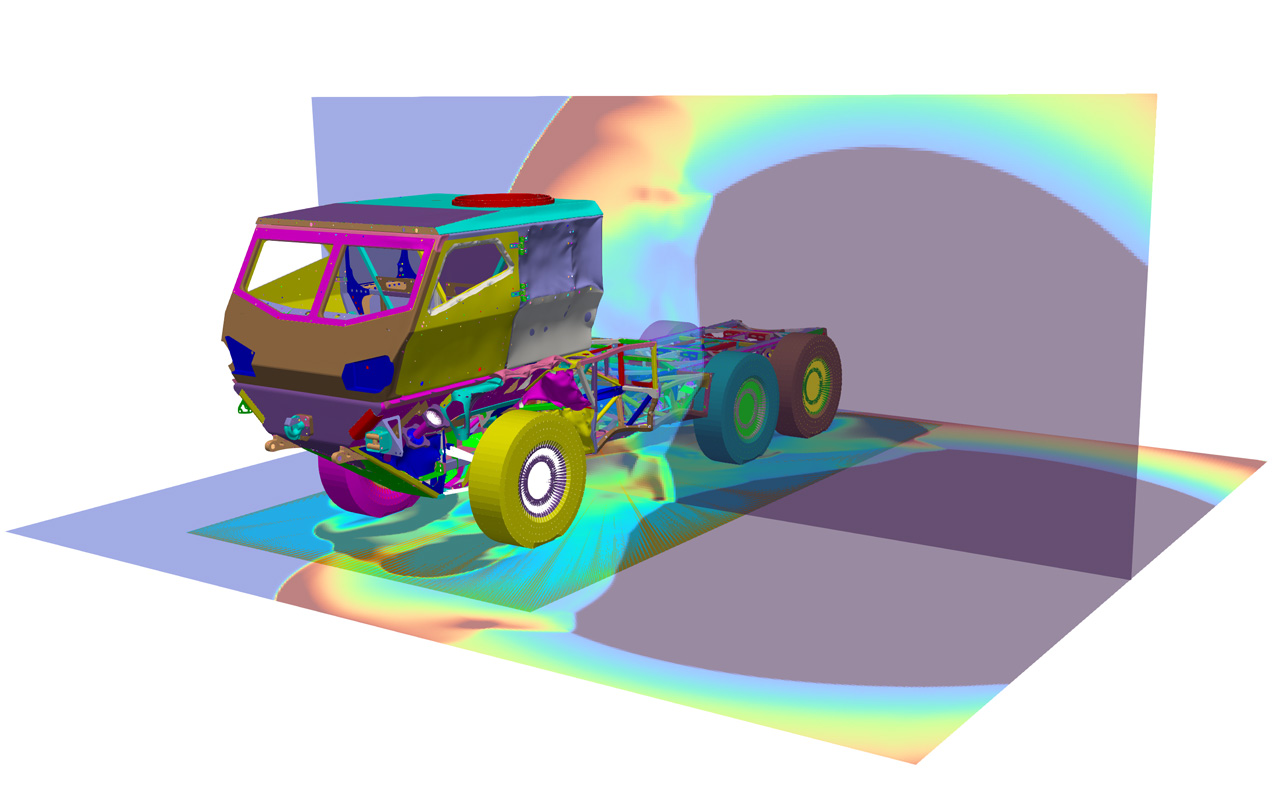
These examples illustrate relevant modelling approaches; they are not presented as marine project case studies.

Need support with a marine structural or shock problem?
Our engineers can work directly alongside your existing team, providing targeted analysis expertise or ongoing technical support as required.